Where Winds Meet Madiao Guide: Rules, Strategy, Rewards
Madiao is one of those mini-games in Where Winds Meet that sneaks up on you. You sit down thinking you’ll play a quick round for a few Resolve points and Commerce Coins, and the next thing you know, you’ve lost an hour or two and possibly your pride. On the surface, it’s a simple bluffing game. In practice? It’s a psychological duel wrapped in centuries of history.
But where did this card game come from? How how do you play Madiao Where Winds Meet? And how do you actually win without stumbling out of Kaifeng digitally tipsy?
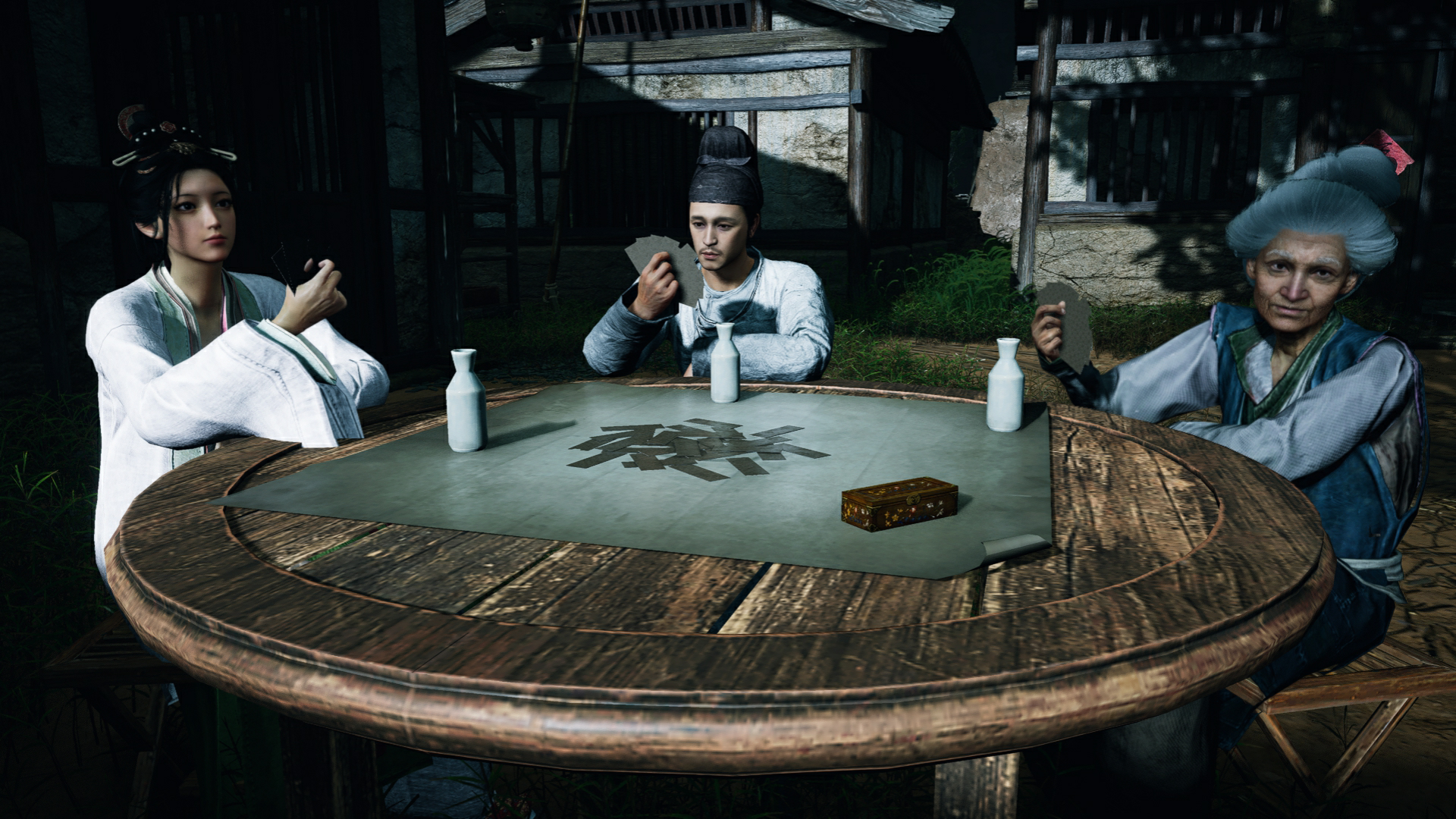
Madiao game in Kaifeng Suburbs North
Madiao is A Game Worth Your Time
Across the taverns and courtyards of Kaifeng and Qinghe, small tables fill with locals hunched over cards. In Where Winds Meet, Madiao isn’t just another mini-game. It’s a part of the very fabric of life in ancient China.
If you’re grinding for Resolve or just need a break from duels and maxing out your skillsets, Madiao something unique: a genuine test of nerve and observation that changes with every opponent.
Playing Madiao reminds me of playing Spades with friends and family. Once you get the hang of it, you stop playing for rewards and start playing for the thrill and fun of it.
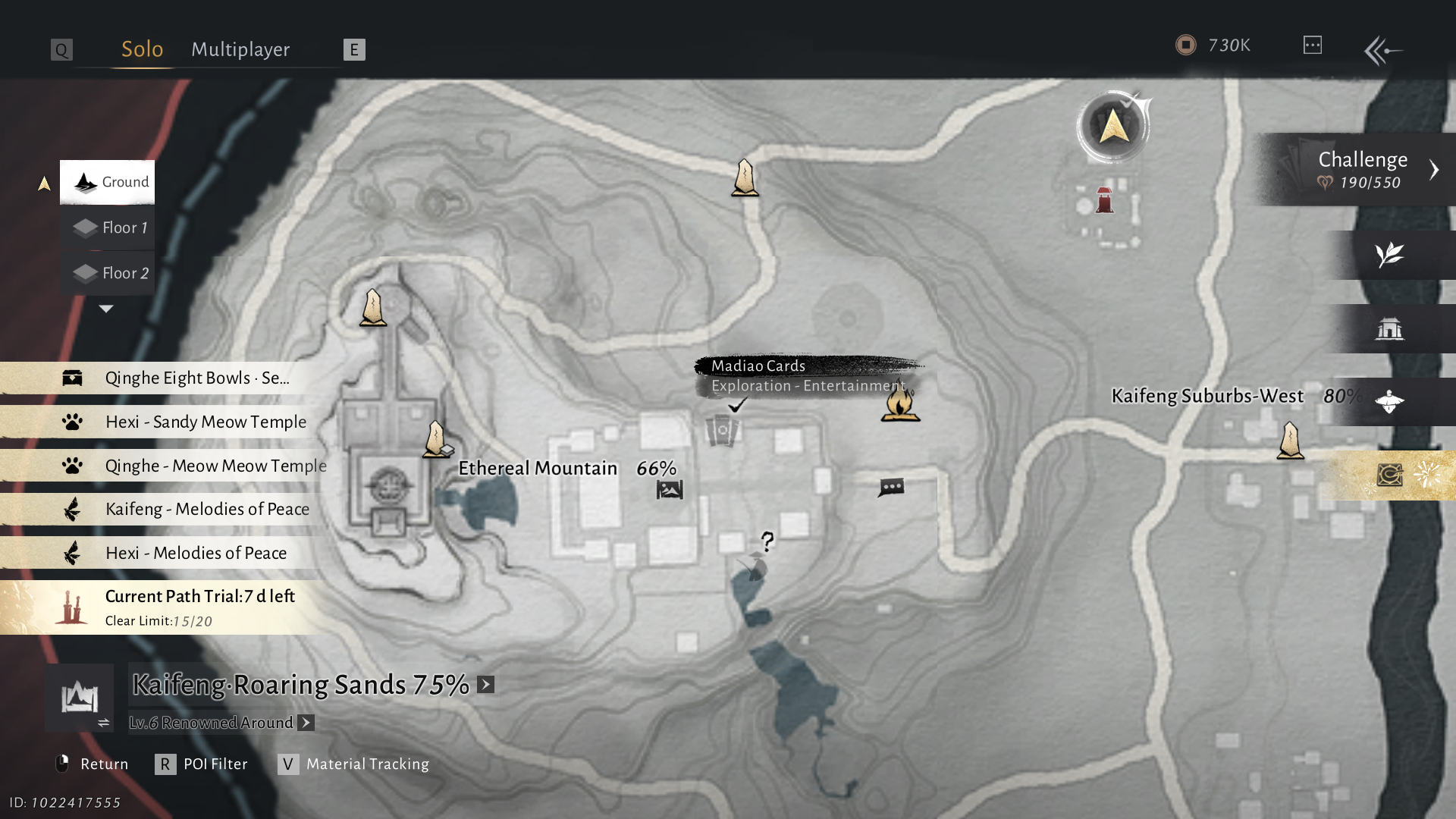
Map location of Madiao Cards
How to Play Madiao in Where Winds Meet
So, you want to learn how to play Madiao. Once you realize it’s really a fun, bluffing game, it becomes easy to get the hang of.
The In-Game Version at a Glance
The developers streamlined the historical trick-taking system into a bluff-focused format that feels intuitive but still tense. It’s fast, readable, and fun. You’ll find tables scattered through Qinghe and especially Kaifeng. Kaifeng has the highest concentration of opponents, making it your best training ground.
Before sitting down, make sure you have enough coins and sufficient Resolve. Requirements vary by table.
Basic Rules
The loop is simple, but the tension builds fast:
One player receives the “One Coin” marker. That means that player goes first.
They declare a number and play cards face-down. (“Four sevens.”)
The next player either lets it pass or challenges.
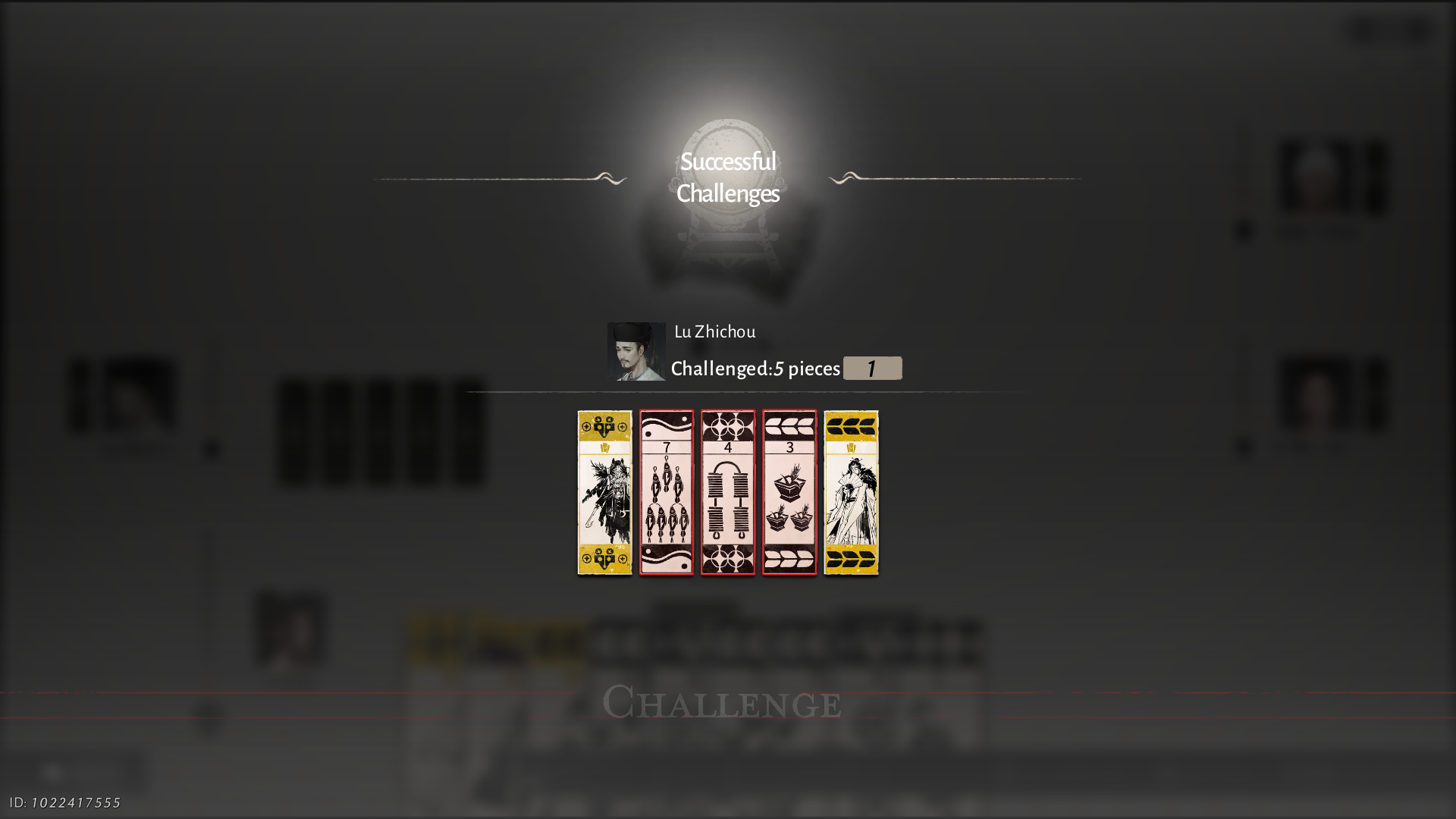
Challenge
If you don’t believe a player’s cards are truthful, you can challenge them.
If they bluffed, they collect the center pile and drink (+25% pass-out chance).
If they told the truth, you collect the pile and drink.
Yellow cards are wildcards, like the Joker in Spades, counting as any declared number.
The round continues until someone empties their hand without passing out.
That’s it. And somehow, that’s enough.
The Drinking Mechanic
Every forced drink increases your chance to pass-out by 25%. This mechanic is brilliant because it escalates tension naturally. Even early rounds are not quite safe. You could drink a cup of poisoned wine with your first challenge. It’s really like Russian roulette with cards and wine. Lose too many challenges, and you’re done.
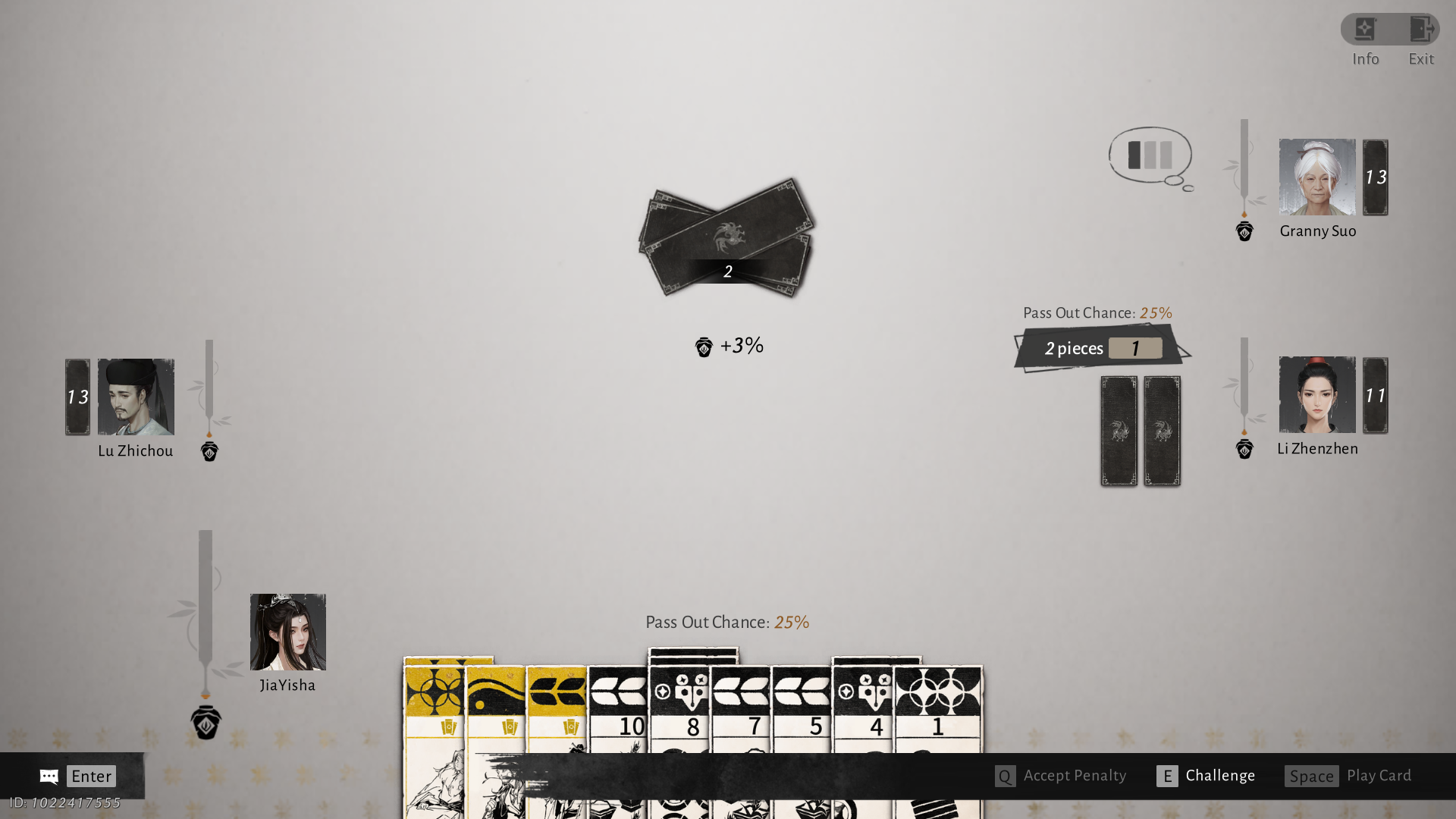
NPC Habits
At each Madiao Cards location throughout Kaifeng and Qinghe, the NPCs’ habits are different. Pay attention each NPC player for a round or two. You will get to know who bluffs most, who plays honest, and can be baited into challenging you.
Why You Should Play It
Aside from it being a lot of fun, winning rewards you with:
Coins
Echoing Jade
Exploration Experience
Resolve Points
Character Experience
Commerce Coins
Compared to other mini-games, Madiao tends to reward more Resolve per win.
How to Win in Madiao Using Different Strategies
Now let’s talk tactics.
1. Open and Honest
Early NPC behavior skews truthful. Use that. Play straight in the first few rounds. Dump awkward singles. Build credibility. When you eventually bluff, opponents hesitate. That hesitation wins games.
2. Be Suspicious of Big Numbers
Declarations of four or more matching cards deserve scrutiny. Wildcards make it possible, sure, but probability is on your side when challenging large claims. Just don’t challenge recklessly if you’re one drink away from blackout.
3. Hoard Your Wildcards
Yellow cards are power. Don’t waste them early unless they secure momentum.
Late-game, they let you make outrageous but technically truthful claims. “Six sevens” hits different when it’s actually valid.
4. Apply Pressure Strategically
Target one opponent after you gain control of a round. Repeated challenges force them to reveal patterns. It disrupts their rhythm and hands you information. Information wins Madiao.
5. Track What You Can
Full card counting is tough. Start small. Track one number at a time. If most eights have surfaced, challenge future eights aggressively. The drinking mechanic adds chaos, so stay focused.
6. Control the Narrative
When you hold the One Coin, choose numbers that serve you. Declare what strengthens your position. If your hand is weak, pick something plausible and bluff with insurance.
Remember, when playing with NPCs, get to know their playstyle first. Confidence matters. Bluffing works best when it feels boring.
The Historical Journey of Madiao
Origins in the Mists of the Yuan Dynasty
Madiao’s exact origins are hazy, but Korean poet Jang Hon (1759-1828) recorded that the game dated back to the Yuan dynasty (1271-1368). What we know with more certainty comes from 15th-century scholar Lu Rong, who documented a 38-card version of the game during his lifetime (1436-1494). And by the early 17th century, Pan Zhiheng and Feng Menglong published detailed rules, cementing Madiao's place in Chinese recreational life. That means, madiao wasn’t just a passing hobby. It was embedded in social life.
Even the name carries poetry. Mǎ (马) means "horse" and diào (吊) means "hanged" or "lifted." It references a visual metaphor: three players versus one banker, like a horse lifting one hoof. Games in imperial China weren’t just games. They were layered with symbolism.
A Card Game of Legend
If you ever order a reproduction Madiao deck, the instruction manual might tell you a different story: that the game was invented during the Tang Dynasty by a figure named Yi Linlong (or Ye Linlong), who created it as a "Leaf Drink Game" to entertain palace ladies.
It's a wonderful story. However, there is no historical evidence of a Yi Linlong in this respect.
The original Tang Dynasty "Leaf Game" (叶子戏, Yezi Xi) was almost certainly a dice-based board game, not a card game. The 40-card money-suited deck we now call Madiao didn't emerge until the late Ming Dynasty, centuries later.
As for Yi Linlong? He doesn't appear in any historical or academic records of Madiao. His name seems to be a romanticized fusion of the legendary inventor "Yezi" (Leaf) and a more elaborate fictional character. It’s a folk etymology that modern reproduction decks have happily embraced. And including Madiao Cards in Where Winds Meet’s culture and social life makes perfect sense.
The Deck That Echoed Through Empires
Traditional Madiao used a 40-card deck divided into four currency-based suits:
Cash or Coins (纹, wén)
Strings of Coins (索瘠, suǒ jí)
Myriads of Strings (万/萬, wàn)
Tens of Myriads (十, shí)
These suits reflected real monetary units, hinting that the cards likely evolved from paper currency used in gambling.
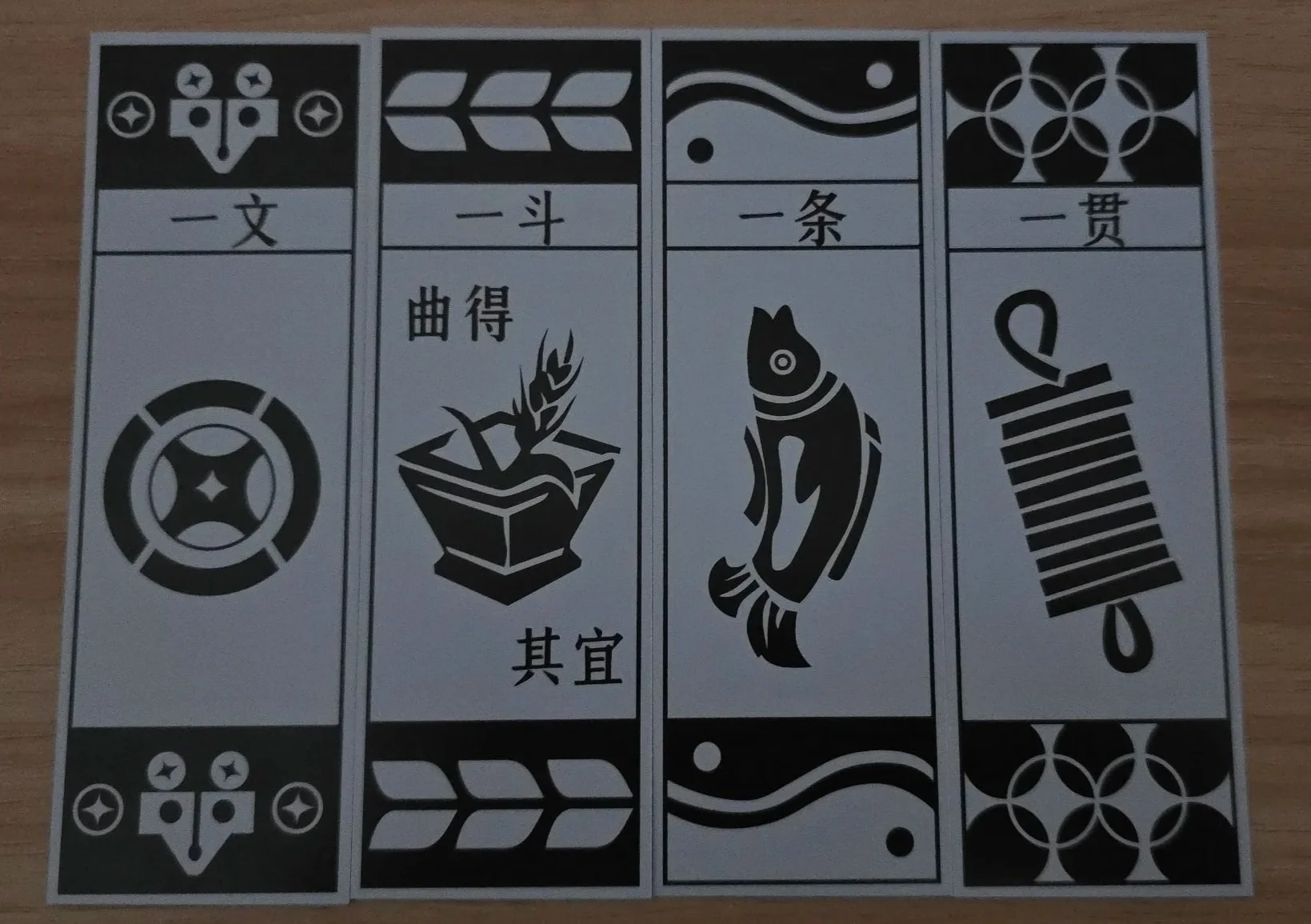
The four Madiao suits from left: Coins, Strings of Coins, Myriads of Strings, Tens of Myriads
The artwork elevated the deck further. Many cards depicted characters from the classic novel Water Margin. Specifically, the 108 Stars of Destiny. So, while you were bluffing, you were also holding legendary outlaws in your hand. Not subtle.
Some cards bore red stamps mimicking official bank seals, marking them as bonus “red cards.” Even visually, the game blurred the line between art, literature, and risk.
From Ming Obsession to Qing Ban
During the Ming dynasty, Madiao exploded across social classes. Scholars, merchants, laborers—everyone played. Contemporary accounts describe it spreading from market towns to the capital, dissolving hierarchy at the game table.
Not everyone approved. Critics blamed gambling for moral decay. After the dynasty fell in 1644, some loyalists even labeled Madiao an omen of collapse.
The new Qing dynasty government cracked down. In 1691, the Kangxi Emperor banned the manufacture and sale of playing cards. But that didn’t work.
Officials still played in private. Nobles still indulged. The rules only grew more elaborate over time.
The Mother of Mahjong
Madiao’s biggest legacy? It eventually evolved into Mahjong.
As card decks shifted to three suits during the Qing era, draw-and-discard mechanics emerged. By the 19th century, those experiments solidified into mahjong. You’ll notice the circles, bamboo, and characters directly mirror coins, strings, and myriads. When you play Madiao in Where Winds Meet, you’re engaging with the ancestor of one of the world’s most recognizable games.
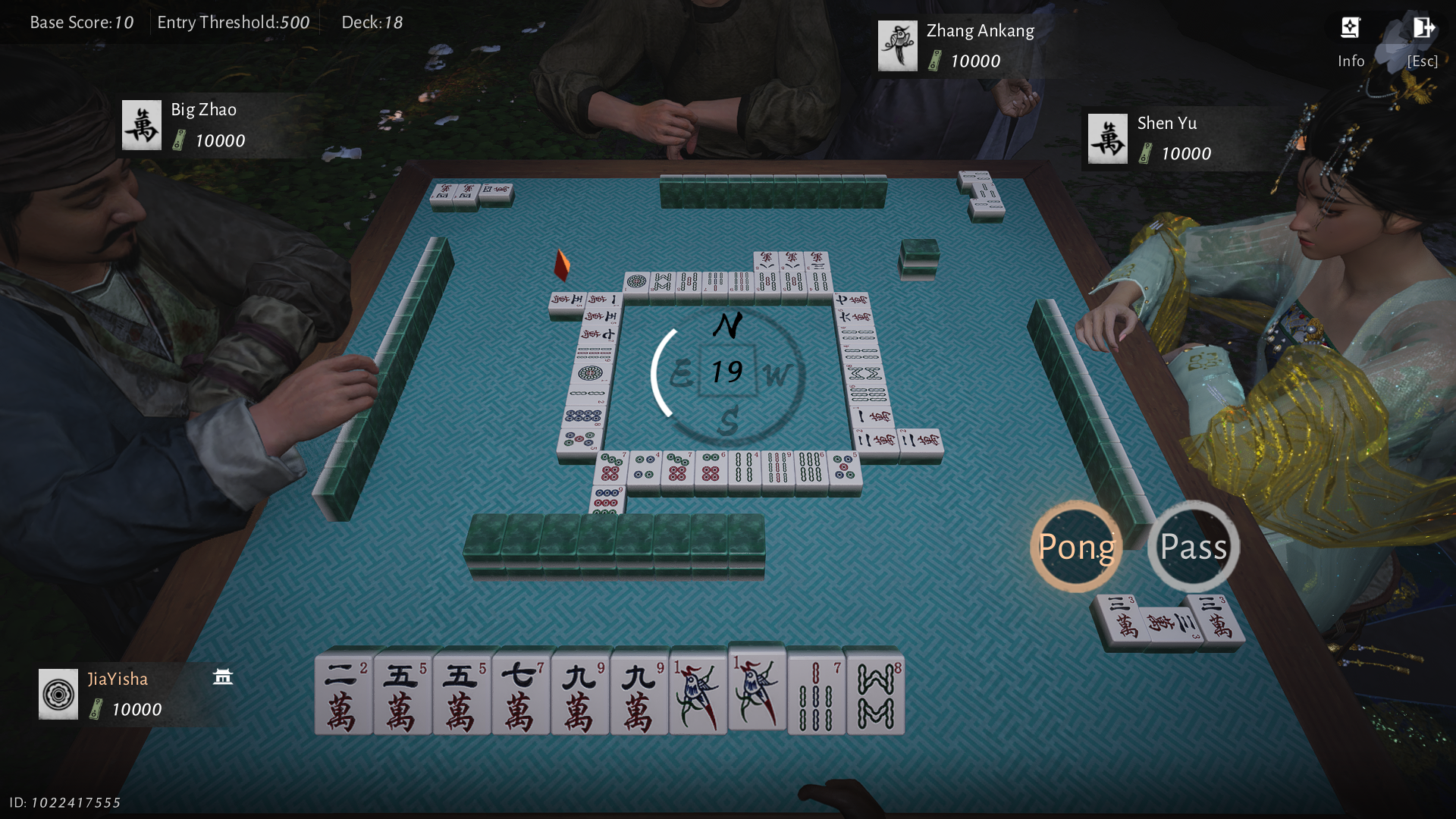
A game of Mahjong God in Where Winds Meet
Why Madiao Was Iconic
The Scholar’s Dilemma
Madiao occupied a strange and fascinating place in Chinese intellectual culture. On one hand, respected scholars wrote detailed strategy guides about the game. On the other, many of those same thinkers openly criticized gambling and the social problems it could create.
That contradiction says a lot about how leisure was viewed in traditional Chinese society.
Late Ming texts known as “card classics” (牌经) didn’t simply explain how to win. They also emphasized etiquette, composure, and discipline. A skilled player was expected to maintain emotional control, respect opponents, and keep the game in perspective. In other words, winning wasn’t the only measure of mastery.
Madiao became more than a pastime; it became a metaphor. Just as players balance risk, patience, and opportunity at the card table, individuals were expected to balance competing responsibilities in life. Strategy, restraint, and good judgment mattered in both arenas.
Framing the game this way allowed educated men to enjoy it without feeling like they were betraying Confucian ideals. Madiao wasn’t simply gambling; it was a test of character.
The Gender Politics of Cards
Madiao also reveals something interesting about gender dynamics in late imperial China.
During the Ming dynasty, card games often appeared in mixed social settings. Women playing games like Madiao could be viewed as cultured companions in elite gatherings, particularly among wealthy families where leisure and literary culture overlapped.
But attitudes shifted over time. By the later Qing dynasty, as Madiao gradually gave way to Mahjong, critics increasingly associated card games with female gambling and moral decline. Those criticisms reveal more about social anxieties than about the players themselves.
For many women of means, card tables offered one of the few socially acceptable spaces for recreation and conversation outside strict household supervision. Games became small pockets of autonomy. They were places where strategy, wit, and social bonding could flourish. In that sense, the game table wasn’t just entertainment. It was a subtle form of social freedom.
Madiao as Political Metaphor
One of the most unusual chapters in Madiao’s history emerged after the fall of the Ming dynasty in 1644.
In the aftermath of the dynasty’s collapse, some scholars began searching for symbolic explanations for the disaster. Retrospective interpretations of Madiao cards started appearing in writings, suggesting that the game’s imagery and structure had somehow foreshadowed the empire’s downfall.
During the early twentieth century, reformers in the Republican period debated whether mahjong, Madiao’s descendant, represented something deeper about Chinese society. Some commentators praised it as evidence of strategic thinking and cultural sophistication. Others condemned it as proof of national decadence and wasted energy. In other words, even centuries later, games were still being used as mirrors for broader political anxieties.
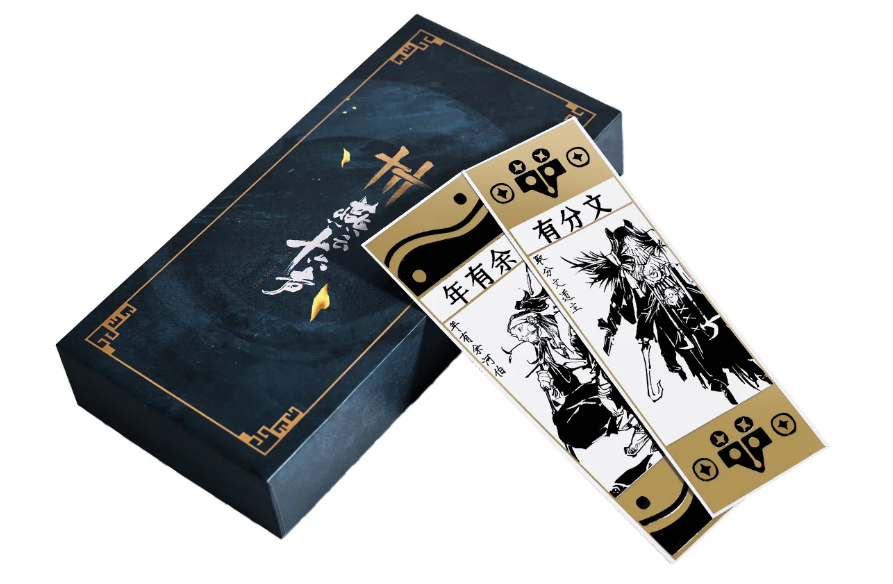
Madiao Card Deck from NetEase Store
The Legacy Lives On
Madiao itself gradually faded from everyday play by the mid-19th century, replaced by newer card and tile games. But its influence never disappeared. Though rare, you can still order Madiao card decks from artisans. Or you can get a Madiao deck from the NetEase Store.
The mechanics and suits of Madiao directly shaped the development of Mahjong, which eventually spread across the world. Elements of its gameplay also echo in regional card traditions across East and Southeast Asia.
And now, centuries later, it appears again inside Where Winds Meet.
When you sit at a Madiao table in Kaifeng, you’re participating in a tradition that once entertained Ming scholars, Qing officials, merchants, and ordinary townspeople alike. The rules may be simplified for modern players, but the core experience remains the same: reading your opponent, managing risk, and deciding when to call someone’s bluff. Some games disappear. Others evolve. Madiao did a little bit of both and that’s part of what makes it so fascinating.
Why You Should Sit Down and Play
Madiao in Where Winds Meet rewards patience and thought instead of repetition. It’s layered. It’s historical. And it genuinely makes you better the more you engage with it.
Play for the Resolve. Stay for the mind games. Open the map, zoom in, and look for the icons of a three-card spread. Head to that location and have fun. And remember: the most dangerous bluff is the one that looks completely ordinary.